DISABILITY & ACCOMMODATIONS
U.S. DISABILITY INFORMATION
In many cases, EMR Syndrome is a disability, as set forth and defined by the Americans with Disabilities Act. Under the ADA, all persons with disabilities, including those with EMR Syndrome, are legally eligible to receive reasonable accommodations.
Definition of disability: According to the 1990 Disabilities Act, a person is disabled if they have a physical or mental impairment that substantially limits one or more major life activities*, have a record of such an impairment, or are perceived as having such an impairment. The ADA Amendments Act of 2008 broadened this definition, expanding the scope of what constitutes "major life activities," and stipulated that the determination of substantial limitation should not consider the effects of "mitigating measures" like medication or assistive devices.
*Major life activities include, but are not limited to:
1. Caring for oneself, performing manual tasks, seeing, hearing, eating, sleeping, walking, standing, sitting, reaching, lifting, bending, speaking, breathing, learning, reading, concentrating, thinking, writing, communicating, interacting with others, and working;
2. The operation of a major bodily function, such as the functions of the immune system, special sense organs and skin, normal cell growth, and digestive, genitourinary, bowel, bladder, neurological, brain, respiratory, circulatory, cardiovascular, endocrine, hemic, lymphatic, musculoskeletal, and reproductive systems.
Do I have a disability?
If your condition meets the above definition by the ADA, then you have a disability.
Are all disabilities the same?
Some disabilities are visible, for example, conditions requiring wheelchairs. Other disabilities are invisible, such as EMR Syndrome. In the U.S., all persons with disabilities have rights that are equally protected under the ADA.
As a disabled person, what are my rights?
Individuals with disabilities have the same right as the general public to the full and free use of the streets, highways, sidewalks, walkways, public buildings, medical facilities, including hospitals, clinics, healthcare provider offices, public facilities, and other public places.
As a person with EMR Syndrome, how do I exercise my rights?
If symptoms of EMR Syndrome are limiting your ability to enter and use a public space, you may ask for a reasonable accommodation in the form of a Disability Accommodation Request.
What is an Accommodation?
An accommodation is a modification or adjustment to a work environment, public space, or policy that enables a disabled person to gain access to facilities, services, and programs available to others. A reasonable accommodation is one that, in its fulfillment, does not cause undue hardship to the party granting the accommodation.
What do the terms “access” and “access barrier” mean?
To have access means to have the ability to enter and use. If you are disabled, equal access to public spaces is a right protected under the ADA. An access barrier is anything that prohibits or blocks your entry to a public space, real or virtual. For the mobility-impaired, a staircase is an access barrier. For people with EMR Syndrome, cellphones, Wi-Fi, smart meters, electronic gates, laptops, etc., may be access barriers that inhibit entry and use of one’s workplace, doctor’s office, hospital, City Council chambers, library, grocery store, etc. Access barriers present an opportunity for change. We can work together to make EMR Syndrome a widely recognized disability by asking for reasonable accommodations under the Americans with Disabilities Act. The general term for the category of access is accessibility.
The 3 areas of disability rights outlined and protected by the ADA are known as Titles I, II, and III. They are as follows:
Title I: Employment
Title I of the Americans with Disabilities Act (ADA) prohibits employment discrimination against qualified individuals with disabilities and requires employers to provide reasonable accommodations, unless it causes undue hardship. This title applies to private employers with 15 or more employees, state and local governments, employment agencies, and labor organizations. It protects both job applicants and employees in all aspects of employment, including hiring, firing, advancement, training, and compensation. Example of a Title I Accommodation advocated by people with EMR Syndrome: If you work in an office, you can request your employer to accommodate you by moving your location to a Safe Zone with no Wi-Fi or other wireless devices, using wired internet access and a corded phone. If you need access to a printer, connections can be made by a wired Local Area Network (LAN). Other accommodations may be needed depending on your job assignments and work settings, such as signage requesting that all wireless devices be turned off, or placed in a Faraday bag before entering the Safe Zone.
Title II: State and Local Governments
Title II of the Americans with Disabilities Act (ADA) prohibits discrimination by state and local government entities, ensuring individuals with disabilities have equal opportunity to access and benefit from their programs, services, and activities. This includes physical accessibility of facilities and services, effective communication, and the provision of reasonable modifications to policies or practices when necessary. Example of a Title II Accommodation advocated by people with EMR Syndrome: You may request your Town Hall or City Council Chambers to accommodate you. For example, you could request access to a town or city meeting remotely via teleconference, if you tolerate using a computer at home.
Title III: Private Businesses
Title III focuses on private businesses that provide services to the general public (also known as public accommodations). All new construction and modifications must be accessible to individuals with disabilities. For existing facilities, barriers to services must be removed if it is readily achievable. Example of a Title III Accommodation advocated by people with EMR Syndrome: You can request a hotel to accommodate you by having Wi-Fi and smart TVs disconnected in your room, and to be assigned a room farthest from other wireless sources and external antennas.
The facts are clear: If you are disabled with EMR Syndrome, federal law protects your right to participate in all aspects of society and provides recourse for reasonable accommodations — the purpose of which is to remove barriers to your employment, education, ability to obtain healthcare, communicate, travel, and more. Further, EMR Syndrome, under the former labels Electromagnetic Sensitivity and Electrohypersensitivity, has been recognized as a disability by the U.S. Access Board, the National Council on Disability (NCD), Housing and Urban Development (HUD), the Social Security Administration, The Department of Defense, The Job Accommodations Network (JAN), and the Centers for Disease Control and Prevention (CDC).
The 4 essential points to communicate in an Accommodation Request are:
- You have a disability and are requesting an accommodation under the Americans with Disabilities Act, Fair Housing Act, or an equivalent state or local law.
- You are disabled by EMR exposure or you have a medical condition that EMR—emitting devices make worse.
- Describe your main symptoms and the access barrier. Be specific about the accommodation you are requesting.
- Your condition has been recognized as a disability by the U.S. Access board and the National Council on Disability.
To optimize your chances of having a Disability Accommodation Request granted, follow the bullet-point advice of experienced safe technology advocates:
- Before investing time… make sure you are requesting your accommodation from someone with the knowledge and authority to make a decision. This might be an ADA coordinator, a customer service department, or a person in a leadership role. For a request to a local government, contact the City Clerk. In some instances, you may wish to begin a conversation at a more familiar level, politely moving upwards if faced with resistance or delays. In a large organization, it may be necessary to bypass management in favor of the legal team. If further help is required, the Department of Justice (DOJ) has an ADA hotline (1-800-514-0301) which will provide technical guidance regarding mandates and other requirements.
- “Reasonable accommodations.” When making a request, remember that you are looking for what the ADA terms a reasonable accommodation --- one that does not cause “undue hardship” to the party granting the accommodation. This means that your request should not alter the fundamental operations of the business, or be an administrative or financial burden.
- Be friendly. Initiating an Accommodation Request should begin a meaningful, interactive process. This approach will pave the way for other requests to be granted.
- Only for you. Make your accommodation request for yourself, as an individual. Requests for a class of people are likely to be denied. Do not mention scientific research, safety limits, or the FCC.
- Be clear. Explain that for you, Wi-Fi (example) is an “access barrier,” just as stairs are for the mobility-impaired. Wi-Fi limits your entry and use of the library (example), an activity available to the rest of the public.
- Accommodation Cards. To help the process, present a Disability Accommodation Card (see color bar below) and be prepared to leave it behind as an educational reminder.
- Helpful hint. If possible, find one or two similarly disabled people in your community who will join you in making the same accommodation request to a library, hospital, healthcare provider’s office, grocery store, etc.
- Interactive process. If your request is immediately denied, be aware you have the legal right to an interactive process, a conversation in which the denial is explained, and you have the opportunity to offer solutions on your own behalf.
- Follow up in writing. After initiating the request, send an email or letter to recap the exchange and create a paper trail.
- Healthcare Provider letter. If asked or deemed appropriate, you may provide a healthcare provider’s letter. All types of healthcare providers are legally authorized to support your request. You don’t need any special testing; if your doctor says you are disabled by exposure to EMR, and advises avoidance or reduced exposure, that’s sufficient. Click here for letter templates.
- Think ahead. If your request is for a meeting or event, make your submission well in advance.
- Stay on track. If an entity objects on the basis of building safety, compliance with the FCC, etc., understand that these arguments have nothing to do with your request. Steer the conversation back to the core issues: I have been injured and disabled by wireless radiation… this bank of wireless laptops is an access barrier that prevents me from accomplishing my job… under the mandates of the ADA, you are required to grant me a reasonable accommodation… such as relocating my desk to a separate area and equipping it with an Ethernet connection.
- Request frequently. Make requests wherever needed, for example… at the hospital, Town Council, library, doctor’s office, etc. By law, requests can be oral or written. However, in the case of an invisible disability, like EMR Syndrome, it is recommended that you make a written request or follow up an oral request in writing.
- Get what you can. Accommodations are rarely perfect. If an imperfect accommodation is granted that provides some relief, take it. That accommodation can be built on and used to get more accommodations in the future.
- Path to resolution. If after exhausting every avenue, a valid request for a reasonable accommodation is denied, click here to follow a standardized response path to seek a resolution.
- Become visible. As you make your accommodation requests, raise awareness of EMR Syndrome by becoming visible in your community. Develop relationships with local legislators by phone, email, or at council meetings. Be out in the open about your disability and share with neighbors and friends. Contact local press and ask them to publish your story.
- Social Security benefits. The Social Security Administration has the authority to provide income to those who are no longer able to work due to an illness or disability. The SSA is separate from the ADA and follows its own procedures. Contact the SSA at https://www.ssa.gov/disability, by phone at 800-772-1213, or in-person at a local SSA office.
Accommodation Card (FRONT)

Accommodation Card (BACK)
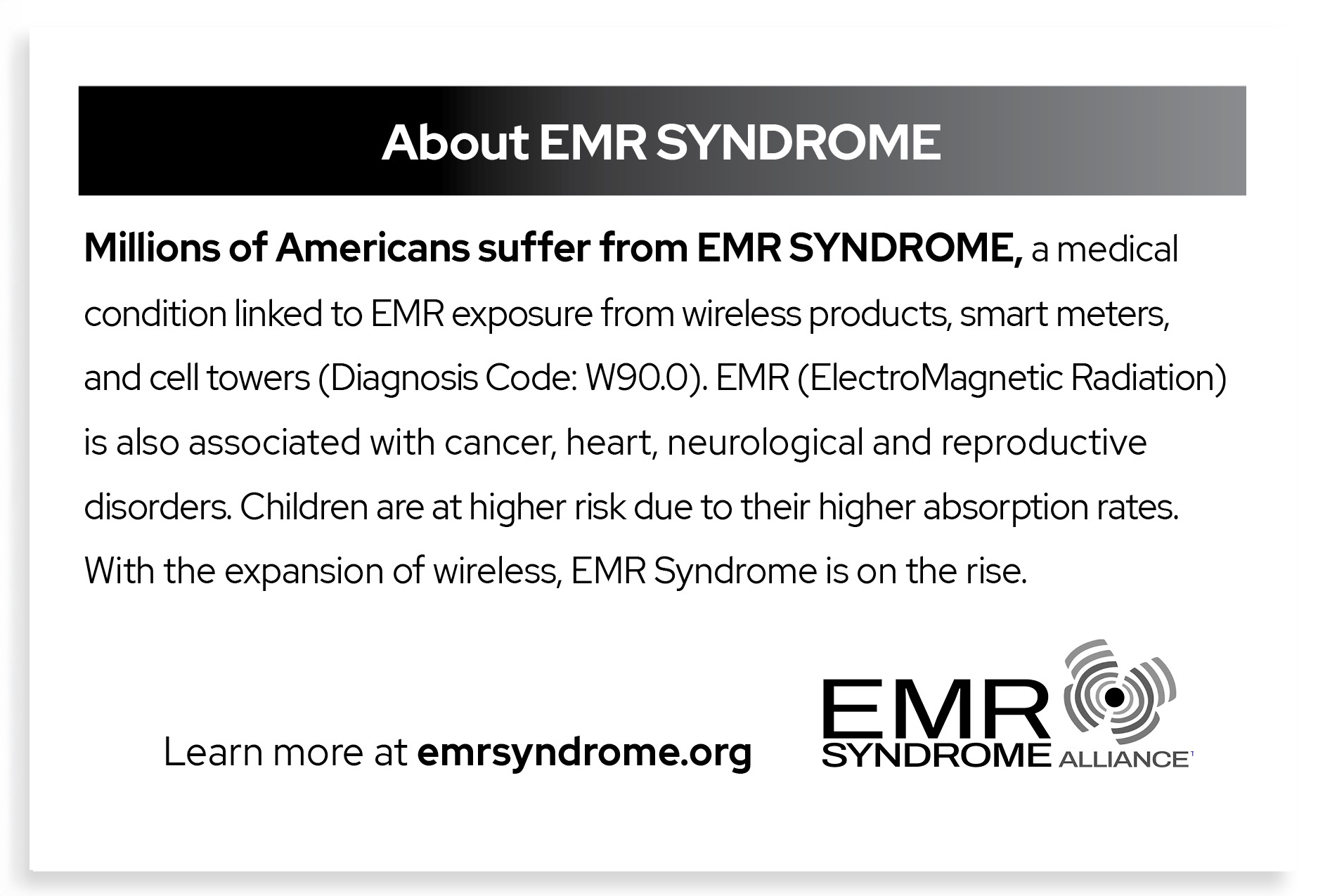
These attractive, sturdy 4x6 inch Accommodation Cards are available at minimal cost by sending your order along with payment to:
EMR Syndrome Alliance
PO Box 62
Holmes, NY 12531
(Please provide your phone # or the best way to contact you if needed.)
Or you may make an electronic Zelle Payment to info@EMRSyndrome.org.
Prices, which include shipping, are as follows:
100 cards: $25
50 cards: $15
25 cards: $10
10 cards: $5
It’s recommended that you purchase the cards in quantity. In this way, you or your representative can present the Accommodation Request in person, initiate a conversation, then leave the card behind as an educational reminder. We are planting seeds everywhere… the Accommodation Card is a fabulous tool to spread the word about EMR Syndrome. While the cards are not legally enforceable, they will inspire civility, educate, and increase the likelihood that your request will be granted.
Please do not attempt to create or copy your own card. A quality card presentation will speak to the validity of EMR Syndrome, the credibility of the information presented, and will educate as we go. If you’re in a tight spot and need an Accommodation Request quickly, you may download an Accommodation Sheet here for temporary use. When making an email request, you may attach the above accommodation sheet and/or document here which defines EMR Syndrome.
Occasions for Use:
Hospital Emergency Rooms
Healthcare Providers’ Offices
Any business establishment or venue where one wishes to be seated or serviced away from a source of EMR, such as a Wi-Fi router… e.g., restaurants, hotels, libraries, retail stores, recreational facilities, and more.
Those disabled by wireless radiation and electromagnetic fields (EMF) need accommodations under the Americans with Disabilities Act (ADA). Several U.S. Federal Agencies have recognized electromagnetic injury.
The U.S. Access Board is the federal agency that develops accessibility guidelines and standards. It plays a vital role in advising state and federal agencies under the Americans with Disabilities Act. In 2002, after the Access Board officially recognized Electromagnetic Sensitivity (one of several historical terms for EMR Syndrome) as a disabling condition, it commissioned the National Institute of Building Sciences to write the Indoor Environmental Quality Report which includes recommendations for building design, modifications, operations, and accommodations for those who have been injured electromagnetically and chemically. The Board memorialized the following in its 2004 determination: “Electromagnetic sensitivities may be considered disabilities under the ADA if they so severely impair the neurological, respiratory or other functions of an individual that it substantially limits one or more major life activities.” Additionally, at that time, the Board indicated that it planned to closely examine the needs of this population, undertake activities that address accessibility, and develop technical assistance materials on best practices for accommodating these individuals. (https://www.access-board.gov/research/building/indoor-environmental-quality/; final rule at https://www.govinfo.gov/content/pkg/FR-2004-07-23/html/04-16025.htm)
The National Council on Disabilities (NCD) issued a framework for health equity in 2022, recognizing electromagnetic injury/disability and recommending mandatory industry guidance and training. These actions will address the needs of those disabled by “electromagnetic and other environmental exposures… [such as] wireless communications and electrical technologies and other sources of non-ionizing radiation, which may trigger disabling and life-threatening cardiac, respiratory, neurological, and other adverse physical reactions.” This recommendation requires “administrative action through HHS Office of Civil Rights, and further research concerning this matter should be conducted by the FDA, NIH, HHS, and HUD.” (https://www.ncd.gov/assets/uploads/reports/2022/ncd_health_equity_framework.pdf).
Disabilitiy advocates delivered a presentation on electromagnetic disability to NCD on May 12, 2022 which included information on the need to provide access and accommodations for people with EMR Syndrome (https://www.electrosensitivesociety.com/national-council-on-disability-ncd-ehs-mcs-presentation-may-12-2022/).
NCD Board Members are appointed by Congressional leadership.
The Job Accommodations Network (JAN), funded by the U.S. Department of Labor’s Office of Disability Employment Policy (DOL/DEP) has issued guidelines that recognize EMS (EMR Syndrome) and list example accommodations that may be provided to employees disabled by EMR (see https://askjan.org/disabilities/Electrical-Sensitivity.cfm#otherinfo and https://ehtrust.org/u-s-department-of-labors-office-of-disability-employment-policy-on-electromagnetic-radiation/).
Environmental Illness has been recognized in the March 5, 1992 legal memorandum from Carole Wilson, Associate General Counsel for Equal Opportunity and Administrative Law to Frank Keating, General Counsel of the U.S. Department of Housing and Urban Development (HUD) on the subject of “Multiple Chemical Sensitivity Disorder [MCS] and Environmental Illness [EI] as Handicaps.” The memorandum concludes that “MCS and EI can constitute handicaps under the [Fair Housing] Act. Our conclusion is consistent with the weight of both federal and state judicial authority construing the Act and comparable legislation, the Act's legislative history, as well as the interpretation of other Federal agencies, such as the Social Security Administration and the Department of Education, construing legislation within their respective domains. The Civil Rights Division of the Department of Justice has also informed us that it believes MCS and EI can be handicaps under the Act. In addition, HUD has consistently articulated this position, and FHEO [Fair Housing and Equal Opportunity] agrees with our conclusion.”
(https://www.hud.gov/sites/documents/GME-0009LOPS.PDF is no longer available; see archived version at https://web.archive.org/web/20251121225545/https://www.hud.gov/sites/documents/GME-0009LOPS.PDF)
The Social Security Administration Office of Hearings and Appeals in 2003 made a determination of severe impairment regarding EMR Syndrome disabilities for a claimant (https://ehtrust.org/wp-content/uploads/Electromagnetic-Sensitivity-Found-to-be-a-Severe-Impairment-by-the-Social-Security-Administration-2003-and-2020-.pdf).
The Department of Defense in 2021 set forth guidelines that recognize injuries that may occur to its personnel from electromagnetic radiation. DoD Instruction 6055.11, “Protecting Personnel from Electromagnetic Fields” (https://www.esd.whs.mil/Portals/54/Documents/DD/issuances/dodi/605511p.pdf).
The Center for Disease Control and Prevention’s 2022 Classification of Diseases Codes Clinical Modification and Procedural Classification System implements the International Classification of Diseases, 10th Revision, Clinical Modification (ICD-10-CM). See CDC webpage (https://icd10cmtool.cdc.gov/?fy=FY2023&query=radiation)
- The ICD-10-CM “diagnosis code” for Radiation Sickness” is “T66.” (https://www.icd10data.com/ICD10CM/Codes/S00-T88/T66-T78/T66-/T66)
- The ICD-10-CM “injury” code for “Exposure to Other Non-Ionizing Radiation” is “W90.” (https://icd10coded.com/cm/W90/)
These codes can cover EMR Syndrome along with other RF exposure-related injuries and maladies.
Additional useful links and resources are provided at the end of the section.

Tell us about your accommodation wins! Small or large, every successful Accommodation Request inspires another. Let us know the town (for example, Wayne, Nebraska), the venue (local library), the access barrier (Wi-Fi), and the accommodation granted (the library has agreed to turn off Wi-Fi every Tuesday 8 to 11am). The EMR Syndrome Alliance will keep a tally of these successes on our website, updated regularly, with your privacy protected. These examples may be used to accompany future requests, sending the message that (other libraries) are making accommodations successfully. Email your accommodation wins to info@emrsyndrome.org.
Remember… you will have successes and you will have denials. In some cases, your request will be granted only after repeated attempts that travel up the line and are backed by a paper trail, a physician’s letter, ADA mandates, and federal agency recognitions. Victory or not, as we press forward together, the path will ease. Even in the face of denial, we’ll be sending a potent, unspoken message about the dangers of EMR, and contributing big-time to the global conversation for safe technology, which is growing louder and louder each day.
The European Accessibility Act is the primary legislation creating common accessibility requirements across the EU: https://natlawreview.com/article/european-accessibility-act-compliance-what-businesses-eu-market-need-know. Several countries in Europe have recognized EMR Syndrome under the name Electrohypersensitivity. These include The Netherlands, Finland, Iceland, Denmark, Sweden, Norway, and regions in Italy. The following links refer to Disability & Accommodations in Europe:
european mediator investigation
CE 13 10 25 proximus maintien decision (3)
Pièce jointe 2 GIA OJ_L_202401309_FR_TXT (1)
2023-134f constitutional court on smart meters belgium
johansson_electrohypersensitivity
https://asso-zonesblanches.org/la-reconnaissance-en-europe/
The UK has not yet passed specific EMR Syndrome disability protections into statute law. In a few noted cases, however, judges have acknowledged the condition and granted EARLY ILL HEALTH RETIREMENT and SPECIAL EDUCATION NEEDS. According to a 2022 press release by PHIRE, (Physicians’ Health Initiative for Radiation and Environment), “disability and compensation cases have been won in many different countries and will continue to escalate. Some legal teams are so certain of negative health effects that civil suits for wireless injury are now being offered on a ‘no win, no fee’ basis, and insurance underwriters consider related risks to be high.”
We welcome any information from abroad regarding standard practice and regulations for Disability & Accommodations. Email info@emrsyndrome.org .
If you have a disability, and have exhausted all avenues to receive a reasonable accommodation, you may wish to pursue a claim by consulting an attorney who specializes in disability law. Finding an attorney is best handled through specific national and local networks that specialize in these protections. Click here for the list. The EMR Syndrome Alliance does not offer legal advice.
In federal, state, and city courts, there have been small-scale victories that are empowering individuals with EMR Syndrome to press claims forward and set new precedents, thus opening the door to the widespread enforcement of disability rights on every level. It’s only a matter of time. The decades-long struggle to enshrine disability rights in law is depicted in the PBS series, Change, Not Charity: The Americans with Disabilities Act.
The advocacy effort — including legal actions — to ensure that people with EMR Syndrome may exercise their disability rights, is in full swing. If you’d like to join the team advocating for accommodations, please email The National Call for Safe Technology at hello@thenationalcall.org.
Click here to find a list of extended diagnosis codes, legal recognitions, and other resources for EMR Syndrome as a disability. You will also find referrals to consultants who assist with ADA accommodation requests. Many more useful links are listed in the Resources and Regulations section below.
Core ADA & Federal Regulations
- ADA.gov: The official ADA website, providing the legal text of the ADA, regulations (Title II & III), and enforcement information.
- Job Accommodation Network (JAN): (askjan.org) Practical, A-Z guidance on workplace accommodations under the ADA.
- ADA National Network: (adata.org) Provides information, guidance, and training on the ADA, including local regional centers.
- Equal Employment Opportunity Commission (EEOC): (eeoc.gov) Enforces Title I (employment) regulations.
- U.S. Access Board: (access-board.gov) Sets technical standards for accessible design.
- Disability Rights Section (DOJ): (ada.gov/disability-rights-section) Information on filing complaints.
Federal Agencies & Mandates
- Rehabilitation Act of 1973 (Section 503/504): Covers federal contractors and entities receiving federal funds.
- Air Carrier Access Act (ACAA): (transportation.gov) Protects air passengers with disabilities.
- Fair Housing Act (FHA): (hud.gov) Protects against discrimination in housing.
- Individuals with Disabilities Education Act (IDEA): (ed.gov) Ensures services for children with disabilities.
- FCC Disability Rights Office: (fcc.gov/general/disability-rights-office) Covers telecommunications.
State & Local Resources
- Disability Information and Access Locator (DIAL): (dial.acl.gov) Connects users to local community organizations.
- Centers for Independent Living (CILs): (acl.gov/programs/centers-independent-living) A nationwide network of community-based organizations.
- State Vocational Rehabilitation Agencies: (rsa.ed.gov/about/states) State-level employment support.
- Aging and Disability Resource Centers (ADRCs): (usaging.org/adrcs) Single points of entry for long-term support.
- State Protection and Advocacy Systems (P&A): (ndrn.org) Legal protection and advocacy services in each state.
Specific Accommodations & Advocacy
- Service Animal Rights (ADA): (ada.gov/topics/service-animals)
- Digital Accessibility Guidelines (W3C): (w3c.org/WAI) Standards for web accessibility.
- National Council on Disability (NCD): (ncd.gov) Federal agency that makes recommendations on disability policy.
Key Contacts
- ACLU Disability Rights: (aclu.org/know-your-rights/disability-rights) Resources for defending rights.
- ADA Information Line: 800-514-0301 (Voice), 833-610-1264 (TTY)
- ADA Regional Centers: 800-949-4232 (Voice/TTY)
Federal Laws & Regulations
Americans with Disabilities Act (ADA) of 1990: The foundational civil rights law that prohibits discrimination against individuals with disabilities in all areas of public life.
- ADA Statute and Regulations: Access the full text of the law and the regulations developed by the Department of Justice on ADA.gov.
- ADA Accessibility Standards: Review the minimum requirements for new construction and alterations in facilities on the U.S. Access Board website.
- Guide to Disability Rights Laws: An overview of the major federal laws protecting the rights of people with disabilities is available on ADA.gov.
Rehabilitation Act of 1973: Prohibits discrimination in programs conducted by federal agencies, those receiving federal financial assistance, and in federal employment.
Individuals with Disabilities Education Act (IDEA): Ensures that children with disabilities have the opportunity to receive a free appropriate public education (FAPE).
Fair Housing Act: Prohibits housing discrimination based on disability and other factors in both private and federal housing programs.
Federal Agencies & Enforcement
These agencies are responsible for enforcing disability rights laws and providing technical assistance.
U.S. Department of Justice (DOJ): Enforces ADA regulations for public accommodations and state/local government services (Titles II and III).
- ADA.gov Homepage
- Report a disability rights violation
Equal Employment Opportunity Commission (EEOC): Enforces the employment provisions of the ADA (Title I) and Section 501 of the Rehabilitation Act.
- EEOC Homepage
- Enforcement Guidance on Reasonable Accommodation
U.S. Department of Labor (DOL) - Office of Disability Employment Policy (ODEP): Provides resources and policy information related to disability employment.
- DOL ODEP Homepage
Job Accommodation Network (JAN): A free consulting service that provides individualized accommodation ideas for employers and individuals.
State and Local Resources
The ADA National Network is the primary source for state-specific information, guidance, and training. They offer a toll-free number that connects you to the center in your region.
- ADA National Network Regional Centers: Find your local center to get answers on specific ADA requirements in your area using the ADA National Network’s regional finder. California and Massachusetts requirements are known to be the most protective in the country.
- ADA Information Line: Call 1-800-949-4232 (Voice/TTY) to speak with an ADA specialist from your regional center.
General Guidance
USA.gov Disability Rights: A general government portal for information on disability rights on USA.gov.
GSA Resources for Americans with Disabilities: Information on accessible government services, technology, and facility design on GSA.gov.
How to Have a Great, Disabled Life: A self-advocacy guide for anyone who is homebound or bedbound in the US https://howtogeton.wordpress.com/.
Membership and Contact Form
Join the EMR Syndrome Alliance today. Our growing numbers will send a message of strength, advocacy and evidence. As a member, you will also be placed on our mailing list to receive selective news and updates.